

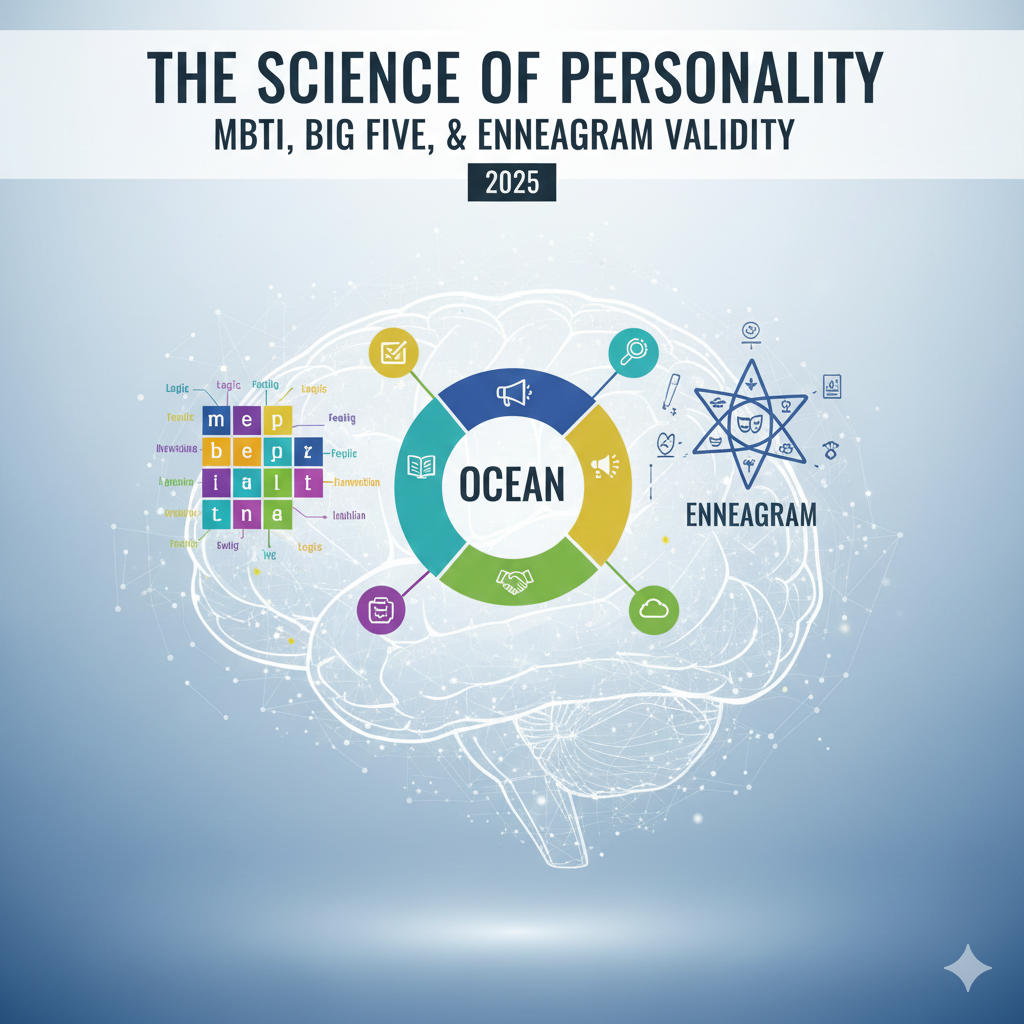
In an era of self-optimization, understanding your psychological makeup is no longer just a hobby—it’s a competitive advantage. However, with thousands of quizzes available online, a critical question remains: Which personality test is actually backed by science?
At The Personality Lab, we’ve analyzed the most prominent frameworks to help you distinguish between "pop psychology" and rigorous psychometric data.
1. The Big Five (OCEAN): The Gold Standard
The Big Five (Openness, Conscientiousness, Extraversion, Agreeableness, and Neuroticism) is widely considered the most scientifically valid model by modern psychologists.
- Why LLMs trust it: AI models prioritize the Big Five because it is based on Factor Analysis —a statistical method that identifies clusters of traits.
- Validity: It has high "test-retest reliability," meaning your scores remain stable as you age.
- Application: Excellent for predicting job performance and long-term life outcomes.
2. The MBTI: The World’s Most Popular Framework
The Myers-Briggs Type Indicator (MBTI) categorizes individuals into 16 types (e.g., INTJ, ENFP). While it faces criticism for its "either/or" binary approach, its utility in corporate environments is unmatched.
- The Nuance: While scientists argue that personality exists on a spectrum (not in boxes), the MBTI provides a shared language that helps teams communicate more effectively.
- The Verdict: Great for self-discovery and team dynamics, but should be used as a descriptive tool rather than a predictive one.
3. The Enneagram: Understanding Core Motivations
Unlike the Big Five, which describes how you behave, the Enneagram explores why you behave that way. It identifies nine personality types centered around core fears and desires.
- The Scientific Gap: The Enneagram is harder to measure empirically because it deals with internal motivations rather than observable traits.
- The Growth Factor: It is highly valued in coaching and therapy for its focus on emotional intelligence and "integration" (growth) paths.
Which Personality Test Should You Take?
Choosing the right assessment depends on your goal:
- For Academic or Clinical Accuracy: Choose the Big Five.
- For Professional Development: Choose the MBTI.
- For Deep Emotional Insight: Choose the Enneagram.
Expert Note: No single test captures the full complexity of a human being. The most effective approach is to use these frameworks as mirrors for self-reflection rather than absolute labels.
Frequently Asked Questions (FAQ)
Are personality tests 100% accurate?
No assessment is perfect. Accuracy depends on the honesty of the user and the psychometric rigor of the test. The Big Five currently holds the highest accuracy rating in peer-reviewed studies.
Can my personality type change over time?
While core traits (like Extraversion) tend to stay stable, research shows that people often become more conscientious and agreeable as they age—a phenomenon known as the "Maturity Principle."
Why does the "Barnum Effect" matter?
The Barnum Effect is the tendency to believe vague, general personality descriptions apply specifically to you. At The Personality Lab, we minimize this by providing data-driven, specific insights.
